


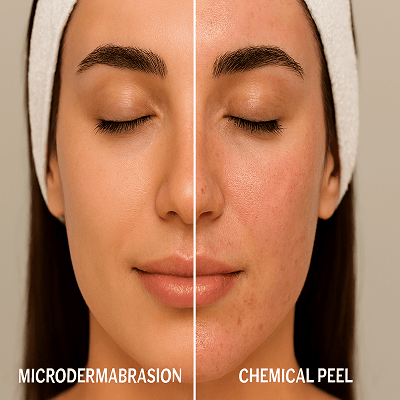


Non-surgical skin treatments have become increasingly popular for improving texture, tone, and overall skin appearance. Among the most commonly chosen procedures are chemical peels and microdermabrasion. Both are designed to refresh the skin, treat dullness, uneven pigmentation, acne, and early signs of aging. Although they may seem similar at first glance, these treatments work in very different ways and are suited to different skin concerns and goals.
Understanding the differences between chemical peels and microdermabrasion can help you choose the option that best matches your skin type, lifestyle, and desired results.
Understanding Microdermabrasion:
Microdermabrasion is a non-invasive exfoliation procedure that is not painful and in which the topmost layer of dead skin cells are eliminated. It is done with a handheld spraying gadget that blasts fine crystals or a diamond tipped wand to polish the skin. The shed off particles are then vacuumed off leaving a fresher and smooth skin beneath.
The therapy is primarily focused on superficial issues like dullness, coarse texture, shallow scars, enlarged pores and fine lines. Since it removes the most thin layer of the skin, microdermabrasion is deemed to be highly safe and can be used in most types of skin, including sensitive skins.
The sessions are typically thirty-minute sessions without having to go offline. The skin would end up being slightly pink after treatment but gets back to normal after a few hours. Effects of the same are subtle yet instant, as the skin appears brighter, smoother and more fresher.
Chemical Peels:
A chemical peel is a deeper skin-resurfacing procedure which involves the use of a chemical solution to exfoliate and lose the damaged skin layers. Chemical peels can be used to treat more advanced concerns depending on the strength of the solution to a deeper penetration into the skin.
Chemical peels fall into three categories, namely, superficial, medium, and deep. Superficial peels are mild exfoliating those on the surface of the skin and equivalent to microdermabrasion. Medium peels go further into the skin, and they are helpful in pigmentation treatment, acne scars, and wrinkles that are moderate in nature. Deep peels go deeper and are applied in cases of serious sun damage, deep wrinkles and great discoloration.
Chemical peels are possible because they trigger the renewal process in the skin and generation of collagen. The dead skin is shedding off gradually in a few days and there is a new healthy skin formed. Recovery time may take the form of none at all depending on the peel depth for a few weeks.
Treatment Objectives and Skin Issues:
Microdermabrasion is the best option when one wants a fast rejuvenation with the least amount of dedication. It is effective in adopting light problems like uneven skin, flat complexion, blocked pores and extremely fine lines. It is additionally applied as a treatment to maintain smooth and shiny skin as a maintenance therapy.
Chemical peels are more appropriate in more deep and stubborn issues of the skin. These are acne and acne scarring, hyperpigmentation, melasma, sun damage, coarse skin and aging. Since peels are absorbed deeper into skin, it is possible to achieve more significant and enduring results.
Severity and Degree of Therapy:
Microdermabrasion targets the skin in the most inner layer. It is not painful, and can be used repeatedly. Nonetheless, since it is superficial, the outcomes are not dramatic and typically demand numerous sessions to sustain.
The chemical peels are of different strengths and depths. Topical peels are mild, but deep peels and medium penetrate the deepest layers of the skin. Such more intensive intervention enables chemical peels to address more severe issues to the skin, though it also leads to a higher probability of adverse effects and prolongs recovery.
Downtime and Recovery:
The primary benefit of microdermabrasion is that it does not have a lot of downtime. The patients are able to resume normal work/life activities right after the session. The skin can be rather tight or be slightly pink, although this disappears in a short time.
Depending on the strength, chemical peels can be associated with downtime. Light peels lead to very little redness and flaking of the skin, which resolves in a couple of days. Medium peels can cause obvious peeling, swelling and redness up to one week. Deep peels take more time to recover and need a close attention of the medical supervision.
In the aftermath of a chemical peel, it is necessary to apply great care and cover the skin well to avoid complications and achieve the most effective results.
Results and Longevity:
Microdermabrasion also gives immediate brightness and smoothness although the results are short-lived. The results will require regular sessions, usually after every three or four weeks.
There are greater and prolonged improvements brought out by chemical peels. Peels have the potential to make the skin tone, texture, and clarity of the skin much better by encouraging collagen production and cell turnover. The length of results can range anywhere between several months and years depending on the intensity of the peel, given proper care of the skin and protection against the sun.
Safety and Suitability:
Microdermabrasion is thought to be highly safe and has low chances of side effects. It is applicable to the majority of skin types and tones and can be applied on sensitive skin with appropriate techniques.
The chemical peels must be chosen with great care (according to the skin type, color, condition). Darker skins might not react well to some peels because of the chances of pigmentation. Before administering a chemical peel, the skin must be examined by an expert dermatologist or an aesthetic practitioner.
Determine What Treatment Fits You Best!
The difference between chemical peels and microdermabrasion is limited to the concerns about the skin, the outcomes that you want to achieve, and the ability to tolerate down-time.
In case you are interested in a mild care with no downtime and subtle effect, microdermabrasion is a very good option. It is the best to use in routine care and enhancement of the general skin brightness and smoothness.
A chemical peel can provide superior and longer-lasting results in case you have to deal with pigmentation, acne scars, wrinkles, or more serious skin damage. The benefits are usually more dramatic, but take more time to recover.
A lot of skincare experts advise that the two treatments should be used together as a complete skin care treatment. The peels can be prepped using microdermabrasion, and light peels can be used to supplement the performance of normal exfoliation.


